1. Top Eight Diet Mistakes And How To Avoid Them

    March 15, 2013

    by Elizabeth Walker

    In the last forty years, America’s obesity rate has almost doubled. Calories are starting to kill more people than cigarettes. And for many, they’re just as difficult to cut back on.

    The good news is that if you’re worried about your weight, dieting doesn’t need to be torture. It is possible to lose weight and still have a life. It’s all about knowing what not to do.

    Here are eight of the most common dieting mistakes. Avoid them and you might just find that dropping a few pounds isn’t as difficult as it seems.

    Cutting out Meals

    Image source: flickr.com/photos/thienzieyung/5267602689/

    Image source: flickr.com/photos/thienzieyung/5267602689/

    Weight loss depends upon the number of calories that you consume, not how many meals you eat. And skipping meals has two major disadvantages. First off, your metabolism will slow down and secondly you’ll be unnecessarily hungry throughout the day.

    The smart way to diet is to eat more meals, not less. Divide your daily calorie intake into six small portions. Doing so will boost your metabolism and allow you to fight hunger more effectively.

    Trying to Eliminate Fat

    Contrary to popular belief, fat isn’t the enemy when it comes to weight loss. In fact, including some fats in your diet can actually help you to lose weight.

    When deciding what to buy at the supermarket ignore the “low fat” labels and focus exclusively on the nutritional information. The only thing that you should be worrying about is calorie content.

    Worrying About Carbohydrates

    Thanks to the popularity of low carb dieting, quite a few people have gotten it into their heads that carbohydrates can make them fat. This is actually completely untrue. Low carb diets work by draining the water from your body. Low calorie diets work by burning fat.

    If you’re on one diet, you don’t need to worry about the other. In other words, if you’re watching your calorie consumption, eat as many carbohydrates as you want.

    Drinking Too Much

    Dieting doesn’t just mean that you watch what you eat, it also means that you watch what you drink. A calorie is a calorie regardless of where it comes from. And three beers has almost as many calories as a Big Mac.

    While you certainly don’t need to go tea total to lose weight, you can’t start throwing back drinks with immunity either. When calculating your daily calorie intake, don’t forget to include the calories that you drink.

    Eating too Much Health Food

    Image source:

    Image source: flickr.com/photos/foodswings/4590408656/

    Another source of calories that many dieters don’t worry about is health food. Just because something is healthy, that doesn’t mean that you can eat an endless supply of it.

    Calories in health food are just as fattening as calories found anywhere else. And you might be surprised to learn just how many calories can be found in apparently “healthy” choices.

    Giving Up Your Favourite Foods

    If you want to lose weight in the long term, giving up your favourite foods is not the way to go. Eventually, you’re going to give into the craving. The smart way to diet is to allow all foods in moderation.

    Don’t be afraid to eat a fattening meal once or twice per week. You might find that allowing yourself the odd indulgence is the very thing that helps you to stick to your diet in the long term.

    Forgetting to Exercise

    Image Source:

    Image Source: flickr.com/photos/the_halfwitboy/6879731812/

    The weight loss equation of a low calorie diet is incredibly simple; burn more calories than you consume. Unfortunately, if you’re not exercising on a regular basis, balancing that equation in your favour can become incredibly difficult.

    Exercise comes in a wide variety of shapes and forms. If you don’t want to join a gym, alternatives include walking, cycling, swimming and organized sports.

    Expecting too Much
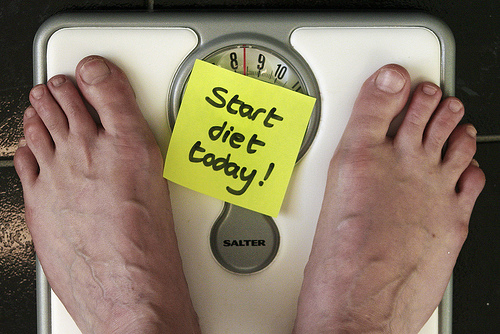
     

    Image source:

    Image source: flickr.com/photos/alancleaver/4222533261/

    Finally, there’s the small matter of your expectations. There’s no faster way to lose motivation for a diet than to set your goals too high. Be realistic, aim to lose approximately two pounds per week.

    Try to lose more than that and you’re more likely to end up disappointed than skinny. The more realistic your goals, the more likely you are to stick to your diet in the long term. And it’s long term dieting that leads to long term weight loss.

  2. Finding Motivation to get back in Shape

    March 9, 2013

    finding motivation to get fit

    by Ann-Marie Stephens

    Whether you are trying to lose weight or simply trying to stay in shape, finding motivation to do it is often easier said than done. This article will not only show you how to stay motivated long enough to achieve your goals, but how to find motivation for all your future goals and ambitions.

    Pre-Requisites to finding motivation

    Finding motivation to achieve any goal in life is like finding that all elusive secret. After all, motivation is the key ingredient to success. Have it, and you can achieve anything. Without motivation, even the most mundane tasks seem impossible. However, motivation itself requires two key ingredients; the will to adopt new approaches (having an open mind), and the need to succeed.

    Step one to finding motivation – replay!

    Most of us feel the need to get back in shape because someone important enough has taunted us a few times about our current shape or we have read some article about the effects of being out of shape.

    If it was a taunt, replay it in your mind again and again until you feel the anger growing within you and the need to do something about it. If it was some article you’ve read, think about the effects of being out of shape that were mentioned in the article.

    The very fact that you are on this page means you already have a reason to get back in shape – focus on it.

    Step two to finding motivation – get past the first week!

    Depending on how out of shape you are, your physical capacity and lung capacity might be severely limited. But know this: the body is very good at adapting. The second day is easier than the first and the third easier than the second. Day after day you will notice your capacity increasing. To begin with, concentrate on doing your exercises daily for one week. Start small and each day increase it by just a bit. By the end of the week you will be seven times better than when you started!

    Step three to finding motivation – Forget the past, start small

    Motivation often falters when we miss our initial targets. For example, when you last exercised, you might have been able to do 10 laps of the pool with only a mild sense of exhaustion. After a long break, start with one lap of the pool. The next day do two and the day after, do three laps and so on. You may think you can do three laps on the first day itself but don’t go for it.

    Step four to finding motivation – Pace yourself

    Remember to increment your exercise routine by tiny amounts. It may take you a tad longer to reach your goal but that is infinitely better than dealing with failure mid-way.

    Step five – Know where the peak lies

    In the example above, I wrote about increasing the exercise volume by a bit on a daily basis. Once you reach (say) five laps of the pool, continue doing only five laps for the rest of the week and then ask yourself how you feel.  Do you feel confident you can add one more lap and sustain it?

    Too many failures result from over-reaching ourselves. On a good day we might be able to do 7 or even 10 laps but that does not mean we can sustain it over a period of time. Knowing your limits is not only the key to staying motivated, it is the key to preventing injuries.

    Step six to finding motivation – Methodology

    Achieving a goal usually requires more than one step. Getting back in shape usually requires us to exercise and replace foods that contribute to the flab with foods that don’t. Measure your success by the completeness of your achievement.

    Step seven – Reward Yourself!

    Achieving all your targets for the first week is a major achievement. See that you give yourself a small reward.  The reward will make you feel good and also remind you of your success.

    Step eight – Sustain your activity

    Successfully achieving all your goals for the first week makes it much easier to continue because you now have the ‘know-how’ to achieve your goals. Remember, tiny increments or if you have reached your target, innovate and make your exercise routine more interesting. Reward yourself at the end of each successfully completed week or month.

    Ultimately motivation comes from the mind and our mind is extraordinarily powerful.  To stay motivated, you must want your target bad enough.

    Some readers had written to me previously saying that they do not think about the exercise while exercising. Instead, they concentrate on thinking about solutions to problems at office and before they know it, they have reached the end of the exercise routine for the day. Experiment around; discover what works best and helps sustain your activity.

    Author Bio:

    Ann-Marie Stephens is a co-founder of the Precise Portions, a dietitian-designed portion control dinnerware system that makes it easy to eat well. Taking the guesswork out of healthier eating; retraining you to eat the right amounts of the right foods, in the right proportion; improving chronic diseases like type 2 diabetes, high blood pressure, and kidney disease. You can find healthy eating information & practical tips on Precise Portions blog.


  3. Deepen Your Yoga Practice with These 8 Goals

    February 28, 2013

    If you’ve been dabbling with yoga, maybe it’s time to take it to the next level by setting some yoga goals, or even one yoga goal.

    The fact is that a progressive yoga practice practice requires setting simple and attainable yoga practice goals in a way that’s not future oriented.

    We do yoga practice to experience a benefit of some sort, so goal-setting is part of that process in order to reach and enjoy the benefit.

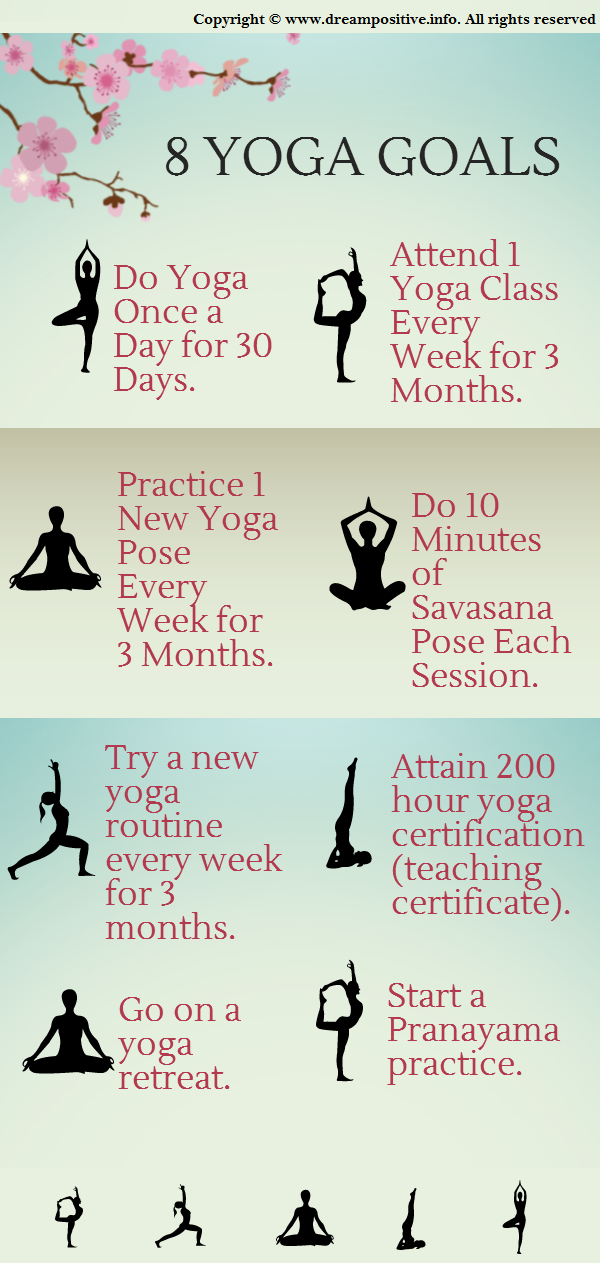
    This inspiring yoga infographic presents 8 great yoga practice goals any yogi can pursue to deepen their practice. The end result of the goals is to help yogis deepend their yoga practice and/or learn more.

    8 yoga practice goals

    Yoga goals are for every anyone looking to deepen their practice … from yoga teachers to the person doing yoga for the very first time. Read this informative infographic today and decide on one simple yoga goal that you can get started with immediately.