1. Positive Thinking? Three Steps To Adopting “Positive Mindset”

    March 28, 2013

    positive thinking

    Image Credit: Junn Kang Too

    Recently, Positive Thinking has become a fashionable and much debated topic in our society. Like any new concept, the positive mindset remains a largely misunderstood idea and sometimes it is being practiced in the wrong way. For example, many people think that having a positive mindset means everything will be okay if they ignore their problems or pretend they do not exist.

    Such thinking is frivolous. Some introspection is required to truly understand and have a positive mindset; one must explore the concept in more depth. I’ve challenged myself to do so, and have come up with the three most important aspects of a positive mindset. These three points are fundamental to applying the concept in a realistic, practical way. We can go further and say, if you absorb these three points and apply them every day, you will benefit from significant improvements in your life.

    So, please read on and consider deeply these three points:

    1. Positive thinking is about taking responsibility for your own life

    A fundamental step to adopting the right kind of positive mindset is the decision to take responsibility for your own life. You must accept that everything that is happening in your life is because of your past actions or inaction. You must stop blaming other people and external circumstances. You, and only you, are responsible for any failures in your life.
    Only you can change your own attitudes and feelings, and then can you handle other people and outside circumstances in a reasonable manner. For example, let’s say it’s raining outside, and that has put you in a bad temper. Your bad mood makes you unproductive at work and argumentative at home.  And all for what? You can’t stop the rain, but you can change your mood. That would be a positive mindset. Do you see what I’m getting at?
    You, and only you, are responsible for your life. Therefore, if you want to achieve something, you must make it happen yourself, nobody else will do it for you. Once you take responsibility for yourself, then you can change your life and start to achieve your goals. However, if you think everything is the responsibility of other people, then you are powerless, and you will never achieve anything.

    Take some paper and write down all the things that you love in your life.

    Now take responsibility for them.

    Well done. You have achieved Point One. You can be proud that you have accepted this responsibility. You are not expecting others to do it. It is YOU, who has gathered together your courage and taken that first decisive step. The good news is that now you have done this, you have control of the situation, and you can start improving it.

    2. Decide what you want

    You have now taken charge of your life and you accept that you are responsible for all your successes and failures. Good. The next step is to decide exactly what you want to do with your life. Positive thinking is mostly about really wanting to achieve your goals and desires, despite everything and everyone around you. If you come up against a difficulty or a problem, don’t just stop and stare at it. You must find a way to overcome it. You can only do that if you know what you want and why you want it. That is why we have Point Two; it is important to decide what you want.
    Stop thinking about what you don’t like and think about what you do like. Concentrate and look deep inside yourself. What are your biggest and deepest desires? Write them down. Say them out loud. Imagine them. Feel them. Visualize them! You see, you do know what you want, and I am sure that immediately you are feeling better for knowing this.
    Sadly, most people surrounding you probably do not know what they want, while they are very good at knowing what you should not want. However, your plans and objectives are none of their business. We are talking about your security, not theirs. These people are obstacles in your path to be ignored, overcome or simply gone around. Stay focused on your goals, and you will surmount all obstacles!

    3. Imagine that you already have it

    At the beginning you might have been sceptical about visualizing your desires. Now is the time to change your mind. Imagine that you already have what you want. Visualize it. The subconscious mind is very powerful! Your subconscious will start thinking about how to achieve that goal, without you realising it.

    In fact, your subconscious mind has always worked for you; you have just never realised it until now. Positive thinking is simply a method for getting in touch with, and using your subconscious mind.
    The more often you imagine that you have achieved your goals, the closer you will come to actually achieving them. Visualization is a tool that successful people use all the time to achieve their goals. If you want to join them, start doing it now!
    If you have read and understood everything written here, then you will have stopped blaming others for a less than perfect situation. By “others” we mean your boss, colleagues, secretary, the opposite sex, government, and the whole world. Now you understand that positive thinking is not an escape from problems. Nor does it mean you can ignore those problems. Instead, it means acceptance and goal-seeking. However, a word of warning – always be realistic in assessing your situation, because positive thinking does not guarantee that everything will be rosy.


  2. Discover The Power And Benefits Of Meditation

    March 23, 2013

    meditation

    Image Credit: Cornelia Kopp

    by Regina Sutherfield

    Meditation is the practice of calming the mind and focusing on stillness in order to relax, soothe the spirit and gain balance. Anyone who is looking for a way to get in touch with their inner self, find peace and serenity and develop the power to tackle life’s problems can benefit from this ancient practice.
    Meditating comes in many different forms but the most important thing to remember is that is simple to accomplish. Different people offer insights into various techniques and methods, and there is no right or wrong way to go about meditating. Some people practice for hours a day while others just need 15 minutes to get in touch with their spirit and develop a sense of peace and calm.

    The aim of meditation is to let go of thoughts, worries, anxieties, fears and doubts and just simply relax and empty the mind.

    The benefits of meditation

    Meditation has limitless benefits that can range from relaxing and unwinding from a long day to addressing health issues or deep emotional scars. Learning the various techniques can help anyone to connect with their spirit and discover the treasure of peace and wellness that lies deep within.

    Meditation can reduce stress an anxiety as well as promote better health. Many sufferers of chronic pain, high blood pressure and other ailments report feeling better after spending a few minutes a day quieting their minds and touching their souls.

    Whether using candles or relaxing music, creating a special place that is free from distraction and full of tranquility can promote a more focused and intentional experience.

    The Best Practices

    One of the great things about meditation is there are no wrong or right methods. What works for one person is not necessarily the best option for another. Some popular techniques to choose from include:

    -Deep and slow breathing.
    -Repetitive chanting.
    -Sitting on a mat or the floor with legs crossed and focusing on a candle.
    -Closing the eyes and concentrating attention on a particular tranquil image or scene.

    Adding quiet music or scented candles can also help to create an environment that will help to calm the mind and refresh the spirit. Anyone who wants to awaken their soul, honor their body and learn how to be in the moment can find effective techniques by attending classes, using at home videos, and researching tactics online.

    Meditation Is a Discipline

    One of the biggest obstacles that people face when learning how to meditate is developing the discipline of being still and at peace. It takes practice and commitment, but a whole new realm of possibilities can be awakened once it is mastered. Meditation should be a fulfilling exercise, and the only way to unlock its true potential is to try different methods until the right ones are discovered.

    Learning from some of the greatest spiritual teachers of our time can be helpful with finding the right techniques that will be easy to put into practice.  Meditation can improve mental well-being and can be effective in the treatment of anxiety and depression.
    The keys to peace, health lie within us. Dedicating a few minutes every day to be still and simply “be” can unlock your hidden potential while promoting balance and overall well-being.


  3. Get The Work/Life Balance Right To Boost Your Confidence

    March 19, 2013

    life-work balance

    Getting the work/life balance correct is often seen as the best way of having a happy and healthy existence but sometimes it’s difficult to cut down on one so you can really enjoy the other. It can be stressful having to juggle too many things and often, as a result, we forget that our own personal happiness has been left on the shelf as we try to please as many people as possible.

    Confidence comes from within and if we’re not able to get the correct balance of who we are and what we do then feeling great about ourselves can often be something of an alien emotion. It is important to value who we are as well as being there for other people and by making just some minor tweaks to your lifestyle you can begin to feel confident and also look amazing.

    Below are five top tips for increasing your confidence levels with the minimum of time constraints and if you’re feeling blue or you feel like you’re slightly unbalanced then read on and see what can work for you.

    Fitness

    Keeping healthy through physical exercise is a tried and tested means of feeding your confidence levels. If you have a shower at work then why not use your lunch break to go for a run? Better yet, hit the local gym or swimming pool for 40 minutes per day and soon you’ll be toned up and blossoming with positivity. There are plenty of ways to get fit before, during and after office hours and just a few minutes each day can make all the difference to your confidence.

    Diet

    The old adage: we are what we eat, is completely correct but sometimes, when we’re chained to a desk or sandwich trolley, it can be tricky to find the right ingredients. With a little bit of time and will-power you can ensure your whole day can be catered for to increase your confidence and lessen your waistline. Stick to nuts, fruit and raw vegetables for snacks and avoid eating late at night. Give yourself a target but don’t be too harsh if you don’t succeed just try and try again.

    Living space

    From tidying up clothes from the floor to doing the washing-up, making sure we live in somewhere that is clean and tidy will work wonders for our confidence levels. Make sure you have a great vacuum cleaner and set aside an hour a week to clean your house or flat from top to bottom. You don’t have to spend the earth to ensure your living space is a representation of yourself but just throw those curtains wide and make the most of what you’ve got.

    Clothing

    What you wear says everything about who you are and how you’re feeling. Try brightening up your wardrobe and purchasing a few special items that make you feel exactly the way you want. Designer jeans, silky vintage lingerie, and that all-important pair of killer heels or boots are exactly what you should consider to help your confidence to flourish. Once you’ve found the right look for you then walk with your head held high and wait for the barrow-loads of compliments.

    Free time

    Lunch breaks, weekends, mornings and evenings, there are so many points in the day that should be reserved just for you. Fill your time with books, culture, physical activities and nature and before long you’ll be feeling great and espousing the values of life to anyone who cares to listen. Find a hobby, join a club or simply enjoy every moment because as soon as you start to get the work/life balance right then the sky’s literally the limit for your confidence levels.


  4. 5 Winning Strategies for Getting into Shape

    March 18, 2013

    at the gym

    Image Credit: Javi

    Many people consider getting into shape as their basic goal. Finding motivation is easy. However, due to our laziness and busy schedule, it takes psychological effort in order to achieve your desired results. Therefore, in order to achieve your desired results, you should stick to a well-designed schedule for getting into shape which should be followed in a good succession. Fortunately, by reading this article you will know five simple strategies of getting into shape which you can adopt for the best results.

    1. Warm up with stretches before the workout-
    It is very important to warm up before engaging into any physical activity. Often you have seen athletes warming up before they take part in any sporting activity. This is important because it aids your body. Warming up increases the blood flow to the working muscles, this in turn reduces your muscle stiffness. As a result there will be fewer injuries of the muscles thus improving your performance in the exercise which you undertake to take. In addition, warming up prepares one’s mentality and improve the range of different motions of the muscles. Warm up session should be of 3-5 minutes prior to the stretching because it will add mobility and fluid to the joints which helps in avoiding injury.


    2. Breathe well during your workouts-

    So as you plan to undertake your exercise you need to breathe properly. Getting correct breathing rhythm helps a person to get the best out of his or her workout. Fatigue will be reduced when you breathe out properly. Important factors should be followed in breathing while working out. Each workout involves a period of pulling out and exerting pressure. When pulling out, you need to breathe out in order to pull out inhaled air while when exerting pressure you need to breathe in order to pull in air.

    3. Resting between the workout-
    The major problem is the Lactic Acid produced in the muscles during the workout. We just feel a burn in the muscles which leads to the failure at the end of the set. Therefore rest between different sets of the workout is very important.  Interval of resting during your workout will allow your muscles to develop and recuperate well and more evenly. Getting into shape will always require a person to maintain proper resting intervals. Two minutes of rest is recommended between each and every set of the exercise for gaining power, strength and muscle mass. If we start the next exercise before the completion of two minutes, we can lack our intensity and strength.

    4. Ensure that you have worked out first for large muscles-
    It is important to work out large muscles first during your exercise since this will increase blood flow into different body parts. As a result, this will prepare other small muscles for workout. In turn, you will get benefit a lot in achieving your desired results. This is the most efficient way of starting your exercise.
    Bigger muscles are required when a person is working out on smaller muscles therefore when you start your exercise on smaller muscles, you will realize that you will not be able to do more on bigger muscles due to them being tired. You will always earn the best results when you start with the big to small muscles.

    5. Work out in each muscle group at least three times in a week-
    It certainly depends on your motivation, but in order to achieve high frequency during training your workout, you should be aiming at least to work out at each muscle group three times in a week. Since training each muscle below three times in a week will not earn you the desired results.
    Depending on your intending outcomes, it is important to set up several winning strategies that you should follow in order to get your desired results. Take your time and ensure that you have followed the above five crucial strategies and you will never regret.


  5. Five Techniques for a Healthier Memory

    March 11, 2013

    Summary: Memory loss is not an inevitable part of aging and with a bit of work it can be prevented. Read on to discover five of the best techniques to help your memory as you grow older…

    Forgotten where you put your house keys? Just been to the shops and discovered half the things you meant to buy are still on the shelf? These things can happen to anyone of any age, but as you get older you might start to worry that aging is causing your memory to subside.

    Growing old brings about physiological changes that can cause issues with the power of recall, but you are not powerless. If you are concerned that you, or a loved one, are starting to suffer from the effects of a worsening memory, living standards can be given a boost through the provision of nursing care. However, there are many steps that can be taken unassisted which will help hugely with memory retention. Here are five of the best:

    1. Sleep Soundly

    During a recent study, scientists from a university in California found that sleep quality has a profound effect on memory as people grow old. The researchers discovered poor sleep causes deterioration in the part of the brain responsible for blending new memories together and over time this can lead to a drop in memory ability.

    This problem can be avoided by getting regular, better quality sleep. Try to establish regular sleeping hours, with stable times for going to sleep and waking up. Getting into a healthy sleeping routine will help preserve your memory power as the years roll by.

    2. Healthy body, healthy mind

    The body can generate new brain cells at any time of your life. Exercising and keeping fit as you get older creates the perfect conditions for new cells to be created, boosting the blood supply to your brain. Exercise has also been shown to alleviate depression and prevent memory-affecting conditions such as diabetes.

    Psychologists recommend that everyone should do at least 30 minutes of moderate exercise five times a week. Building physical activity into your daily routine is a great way to improve your psychological health and brain health. Maybe you could take up a sport, or go for a walk every day. Whatever you decide, you’ll be providing a great boost to your memory power.

    3. Keep well fuelled

    Your brain is a delicate piece of equipment and to keep it running smoothly you really need to make sure you give it the proper fuel. A proper diet can be as beneficial to your mind and memory as it can be for your heart and body.

    Foods that are rich in omega-3 fats, such as salmon and tuna, are good for the brain and memory so should become an integral part of your diet. Also, make sure to take on plenty of fruit and vegetables – foods that are high in antioxidants which can offer brain benefits.

    4. Use it, don’t lose it

    Carrying out challenging mental activities can keep the brain healthy, forcing your mind to create new neural connections and preserve old ones. Mental connections are vital to the process of memory recall, so keeping the brain working is enormously helpful in preserving memory function.

    Improving your concentration is a key part of this process. Memory and attention improvement courses such as Cogmed are specifically geared towards training this ability, something which should really help to boost your memory power. By mixing cutting edge science (Cogmed program was developed and evaluated world famous neuro psychologists) with innovative design the online training system aims to improve your working memory by increasing your capacity to focus on and retain vital information.

    Outside of targeted memory-improvement programmes, there are plenty of other activities that you can do which will keep you mentally challenged. The key to the process is keeping your mind active – so watching documentaries doesn’t count! Here are a few of the things you could build into your daily routine:

    • Complete a  daily crossword
    • Take up a new musical instrument
    • Learn a language
    • Take a part-time course at a local education centre
    • Volunteer at a local community organisation


    5. Organise your way to a better memory

    Psychologists recommend implementing some extra systems to increase order in your life can boost memory power. Creating a diary in which you can jot down tasks and important dates will give you an extra resource to make sure information is not forgotten. And creating a space for items like keys, wallets and purses can ensure that these important items are not mislaid.

    If you’re in a care home, or believe that you may need to enter one soon, many of these organisational tasks will be taken care of. However, there are always things that you can do yourself to boost your memory power and often putting in that little extra effort is enough to provide a big memory boost.

    Protecting this vital asset

    The peerless Renaissance artist Leonardo da Vinci summarised the significance of memory beautifully when he wrote: “Men wrongly lament the flight of time, blaming it for being too swift; they do not perceive that its passage is sufficiently long, but a good memory, which nature has given to us, causes things long past to seem present.”

    A good memory can transform your experience of life so please do try these tips for a healthier memory and let us know which ones worked best for you.

    What’s your memory like? Do you have a favourite memory retention technique? We would like to see your suggestions in comments section…

    Image credit: http://www.flickr.com/photos/76029035@N02/6829467731


  6. Finding Motivation to get back in Shape

    March 9, 2013

    finding motivation to get fit

    by Ann-Marie Stephens

    Whether you are trying to lose weight or simply trying to stay in shape, finding motivation to do it is often easier said than done. This article will not only show you how to stay motivated long enough to achieve your goals, but how to find motivation for all your future goals and ambitions.

    Pre-Requisites to finding motivation

    Finding motivation to achieve any goal in life is like finding that all elusive secret. After all, motivation is the key ingredient to success. Have it, and you can achieve anything. Without motivation, even the most mundane tasks seem impossible. However, motivation itself requires two key ingredients; the will to adopt new approaches (having an open mind), and the need to succeed.

    Step one to finding motivation – replay!

    Most of us feel the need to get back in shape because someone important enough has taunted us a few times about our current shape or we have read some article about the effects of being out of shape.

    If it was a taunt, replay it in your mind again and again until you feel the anger growing within you and the need to do something about it. If it was some article you’ve read, think about the effects of being out of shape that were mentioned in the article.

    The very fact that you are on this page means you already have a reason to get back in shape – focus on it.

    Step two to finding motivation – get past the first week!

    Depending on how out of shape you are, your physical capacity and lung capacity might be severely limited. But know this: the body is very good at adapting. The second day is easier than the first and the third easier than the second. Day after day you will notice your capacity increasing. To begin with, concentrate on doing your exercises daily for one week. Start small and each day increase it by just a bit. By the end of the week you will be seven times better than when you started!

    Step three to finding motivation – Forget the past, start small

    Motivation often falters when we miss our initial targets. For example, when you last exercised, you might have been able to do 10 laps of the pool with only a mild sense of exhaustion. After a long break, start with one lap of the pool. The next day do two and the day after, do three laps and so on. You may think you can do three laps on the first day itself but don’t go for it.

    Step four to finding motivation – Pace yourself

    Remember to increment your exercise routine by tiny amounts. It may take you a tad longer to reach your goal but that is infinitely better than dealing with failure mid-way.

    Step five – Know where the peak lies

    In the example above, I wrote about increasing the exercise volume by a bit on a daily basis. Once you reach (say) five laps of the pool, continue doing only five laps for the rest of the week and then ask yourself how you feel.  Do you feel confident you can add one more lap and sustain it?

    Too many failures result from over-reaching ourselves. On a good day we might be able to do 7 or even 10 laps but that does not mean we can sustain it over a period of time. Knowing your limits is not only the key to staying motivated, it is the key to preventing injuries.

    Step six to finding motivation – Methodology

    Achieving a goal usually requires more than one step. Getting back in shape usually requires us to exercise and replace foods that contribute to the flab with foods that don’t. Measure your success by the completeness of your achievement.

    Step seven – Reward Yourself!

    Achieving all your targets for the first week is a major achievement. See that you give yourself a small reward.  The reward will make you feel good and also remind you of your success.

    Step eight – Sustain your activity

    Successfully achieving all your goals for the first week makes it much easier to continue because you now have the ‘know-how’ to achieve your goals. Remember, tiny increments or if you have reached your target, innovate and make your exercise routine more interesting. Reward yourself at the end of each successfully completed week or month.

    Ultimately motivation comes from the mind and our mind is extraordinarily powerful.  To stay motivated, you must want your target bad enough.

    Some readers had written to me previously saying that they do not think about the exercise while exercising. Instead, they concentrate on thinking about solutions to problems at office and before they know it, they have reached the end of the exercise routine for the day. Experiment around; discover what works best and helps sustain your activity.

    Author Bio:

    Ann-Marie Stephens is a co-founder of the Precise Portions, a dietitian-designed portion control dinnerware system that makes it easy to eat well. Taking the guesswork out of healthier eating; retraining you to eat the right amounts of the right foods, in the right proportion; improving chronic diseases like type 2 diabetes, high blood pressure, and kidney disease. You can find healthy eating information & practical tips on Precise Portions blog.


  7. Yoga Brings Positivity in You

    March 7, 2013

    More and more people are doing the downward dog than ever before. But just what are the benefits of yoga on positive thinking? And how can you incorporate yoga into a healthy holiday? 

    Img4: Psychological and physiological benefits of Yoga

    The psychological and physiological benefits of yoga

    Yoga to keep fit: For a lot of people, yoga is one of the very best things that you can do to feel good. The physical benefits are obvious. Yoga can help you relieve back pain, increase physical fitness, lung capacity and flexibility. Because yoga is all about deep breathing and stretching, it increases the oxygen supply to different parts of the body, which helps to ease tension and improve circulation.

    To relieve stress: But more than that, yoga is accepted by most psychologists as an effective complimentary therapy for all kinds of stress-related disorders. Psychological conditions like depression, anxiety, cardiac disease and high blood pressure can be alleviated with regular yoga practice.

    How, you may ask? Yoga encourages you to focus on your breath and your body, which brings you back to the present moment and stops you worrying about the past and the future. Yoga makes you feel more comfortable in yourself, more motivated and less affected by the outside world. It helps you focus on positive aspects of life and is a major contributor to your psychological well-being.

    Yoga and psychotherapy: In the US, psychologists and psychotherapists have been using yoga as a compliment to talk therapy. The idea is that it’s not only the mind but also the body that needs to be worked on. “Talk therapy such as cognitive-behavioural therapy  can be helpful in finding problem-solving strategies and understanding your own strengths and what’s happening to you, but there are times when you just need to kind of get moving and work through the body,” says Melanie Greenberg, PhD, a psychologist at Alliant International University.

    To be part of a group: Taking part in group yoga sessions can foster a sense of belonging and of being a part of something much bigger than just yourself. This is really positive. It’s a collective experience of everyone moving together, breathing together and in the end relaxing together that is rarely experienced elsewhere.

    A yoga-informed outlook: Simply incorporating the principles of yoga into your everyday life – compassion, non-judgement, spirituality and the connection between all living things – is likely to make you feel less stressed and improve your mental health.

    Enjoy practicing yoga at a yoga retreat?

    If you practice regularly, going on a yoga retreat could be the perfect healthy holiday to recharge your batteries.

    Practising twice a day in a new environment will help you break free of old patterns and familiar routines, at the same time as deepening awareness of your body.

    Spending time away from the distractions of modern society will help you find peace with yourself and inspire you to live a healthier lifestyle when you return home.

    Here are five great yoga retreat ideas around the world:

    Tilton House, UK

    Img3: Psychological and physiological benefits of Yoga

    Set in the idyllic rolling hills of the South Downs in Sussex, Tilton House (www.tiltonhouse.co.uk) regularly hosts weekend Hatha sessions for all in their yurt. Included in the package is comfy accommodation, food, massages and country walks. Its close proximity to London makes Tilton House an excellent addition on a trip to the capital. 

    The Yoga Farm, Costa Rica

    Img2: Psychological and physiological benefits of Yoga

    Yoga retreats don’t come much more picturesque than The Yoga Farm (www.yogafarmcostarica.org) near Pavone, Costa Rica. As well as yoga sessions on a deck overlooking the ocean, the centre offers surfing lessons and two healthy vegetarian meals per day. Yoga Farm is completely off grid with solar panels, a garden for growing their own food and eco-friendly accommodation.

    Les Passeroses, France

    Img1: Psychological and physiological benefits of Yoga

    Les Passeroses (www.passeroses.com) near Angouleme in south-west France is the perfect retreat for anyone wanting to practise Iyengar yoga in a rustic, rural setting. The light and airy converted barn yoga space has been voted by some teachers as their favourite place to take classes. A typical day will involve two sessions of yoga, meditation and as many philosophical discussions and cups of chai tea as you wish.

    Yoga Barn, Bali

    Img 5: Psychological and physiological benefits of Yoga

    In the mountain village of Ubud, Bali, visitors can enjoy a spiritual retreat in one of Asia’s most enchanted hideaways (www.theyogabarn.com). The centre runs seven yoga classes per day – ranging from Yin Yoga to Ashtanga – in two mud-walled studios overlooking the rice paddies. You are free to pick and choose the ones that suit you. An on-site café serves mainly raw-vegan foods, ensuring you’ll eat well and feel healthy on your trip.

    Lotus Yoga Retreat, Goa

    Img 6: Psychological and physiological benefits of Yoga

    Situated right on Goa’s beautiful Patnem Beach, Lotus Yoga Retreat (www.lotus-yoga-retreat.com) is the perfect getaway for ocean lovers looking to unwind in a natural, peaceful setting. The retreat contains at least two yoga classes per day, along with accommodation in bamboo huts and vegetarian buffet meals. Guests are encouraged to book a massage or explore Goa’s sacred temples and colourful markets in their free time.


  8. Small Changes For Your Good Health

    March 3, 2013

    Changes for good health

    Image credit: Sachiho @Flickr.com

    by Alice Lucette

    Who says the road to a fitter, healthier you must be painful? Experts tell us that with a positive attitude and a few small (some of these are even fun!)  lifestyle changes, we can put momentum into our fitness routine, improve our health and even enhance our sense of well-being.

    We’ve scoured the fitness and health pages and have come up with seven small, easy life-changing habits that have big benefits!

    Make your a.m. coffee at home

    If your morning routine includes a daily trip to the coffee shop, try brewing it at home instead! Set the coffeemaker to start automatically a few minutes before your alarm — then wake up to the smell of fresh coffee from your own kitchen. Not only will you save dollars that quickly add up, you’ll also avoid those irresistible, high-calorie sweet treats.

    Sleep in your Yoga pants

    This one sounded crazy until I thought about how a t-shirt and yoga pants double nicely as jogging gear and pajamas! Just hop out of bed in the morning and you’re nearly ready to head out the door — the time you save searching for workout clothes means less time to change your mind!

    Wear a pedometer

    Personal trainer Helena Collins of Boston, MA refers to the pedometer as the world’s most effective fitness tool! Why? Because not only is it super-affordable, when you see how many steps you take in a day you’ll be motivated to move even more. Get one for your spouse or grandkids and challenge each other — soon you’ll all be stepping up your fitness by at least a notch!

    Use a smaller dinner plate

    In a study from the Cornell Food and Brand Lab, author Brian Wansink writes that we are likely to serve ourselves 22 percent fewer calories when we use a 10-inch plate rather than a 12-inch dinner plate. Try filling at least half your plate with fruits and veggies instead of the higher calorie foods, the fiber will keep you feeling satisfied longer.

    Go swimming!

    A dunk in the pool will cool you off in summer and get you warmed up in a chilly Canadian winter. We’re buoyant and therefore lighter in the water, and it’s providing resistance to our every move. An aerobic workout is easier in the water plus we’re strengthening and toning our muscles including the heart. The American Heart Association reports that with 30 minutes of daily exercise such as swimming, we can lower our risk of heart disease by as much as 40 percent!

    Eat at 2 to 3 hour intervals

    You read that right! Eating smaller more frequent meals each day will keep you satisfied and help you resist the urge to binge at dinnertime or worse yet, late in the evening. The trick is to eat healthy balanced meals and snacks — the body will know to burn the calories you’re regularly consuming rather than going into ‘survival’ mode. Your metabolism will level out and you’ll have the energy to get through the day — while feeling good about it!

    Compliment yourself

    Tell yourself you’re awesome — and focus on what your amazing body does for you. Stacey Rosenfeld, Psychologist and PhD practicing in New York and California tells us that the best thing we can do for ourselves is learn to marvel at the body and it’s abilities. Rather than focusing on how we look, think about all that our bodies do for us daily. Stand in front of the mirror and remind yourself of 10 things you like about you! Our bodies allow us to dance and swim, to play with our grandkids and hike with our friends. The key is to feel confident in our abilities and in ourselves.


  9. Does Positive Attitude Assist Healing Process?

    March 1, 2013

    Positive attitude

    Image credit: The Doctr @ Flickr.com

    It’s a debate that has gone on for years, and continues to be discussed by physicians and psychologists. The issue of whether positive thinking affects the medical treatment of patients is one that is hard to resolve. Many patients have seen positive, traceable results when they focused on staying optimistic, but psychologist Richard Sloan, a professor of behavioral psychology at Columbia University Medical Center, says that for every patient who has seen results from positive thinking there may be others who thought the same thing and are no longer alive. That said, public figures such as Lance Armstrong, Gabrielle Giffords, and others attribute a large part of their recoveries from serious illnesses and injuries to their strong spirits.

    Although it’s hard to prove, there have been many cases where a positive outlook showed traceable medical improvement in a patient. This confirms the theory of the placebo effect. The placebo effect is defined as “the measurable, observable, or felt improvement in health not attributable to an actual treatment.” In other words, it is when patients are given sugar pills in place of regular medication, or are told that a medical procedure was done, when in reality it was not done, and a measurable improvement occurs. There have been numerous cases where the placebo effect showed marked improvement in patients’ medical conditions, even though no real medical intervention was being administered.

    In 2007 researchers from the University of British Columbia tested the placebo effect on patients with Parkinson’s disease. They gave one group of patients apomorphine, a drug which mimics dopamine, a chemical in the brain that is deficient in patients with Parkinson’s. They gave the second group a placebo, and they, too, released dopamine, in response to the expectation of receiving medication. This study clearly proved the validity of the placebo effect, and as such, that the mind has a large role in medical treatment of the body.

    While physicians and psychologists will continue to debate the issue, there can be no harm in focusing on a good outcome, and it may actually lead to improved results. Dr. Deepak Chopra is a big believer in the power of the mind when it comes to healing. He explains that one who is at peace with himself can reap the benefits of positive thinking, which can include a decline in high blood pressure, weight, stress levels, and other negative symptoms. In Dr. Chopra’s words in an article for the Huffington Post, “The everyday choices we make affect not only our physical health, but all dimensions of our collective health and well being. This is not to say that pharmaceutical and surgical interventions are not warranted… But looking at them to solve all of our illnesses has made us as a society overlook the powerful self-healing mechanisms within us.”

    The objective of practicing positive thinking is to make use of the healing systems that lie within our bodies to help assist in recovery from various illnesses.

    External factors can help patients maintain a positive attitude. Studies have shown that even the scrubs worn by nurses can help improve patients’ state of mind, which can then help them recover. In a study done on hospitalized children in Florence, a large percentage of the children were more confident in their nurses, and were uplifted when their nurses wore printed or colored Carhartt scrubs. While the donning of Carhartt uniforms is only a small factor in the grand scheme of treatment, everything that contributes to a positive state of mind can help facilitate patient recovery.

    A crucial aspect in keeping patients upbeat is adequate family support. Family and friends who visit often and show the patient that they care can have a marked improvement on treatment, as they will cause an uplift in spirits, which can only lead to good things. Doctors, also, will usually make the effort to visit patients and address their fears before a procedure so that the patient will be calm, and the procedure will go smoothly. A good bedside manner is very important in a doctor, and some patients will choose one doctor over another based on this, because the doctor’s bedside manner will also affect the patient’s attitude.

    The Mayo Clinic strongly recommends that patients should practice positive thinking techniques throughout the day, in order to train themselves to think optimistically. They provide tutorials and exercises for patients to become positive thinkers, in order to facilitate the medical treatment being administered.

    Patients have an array of options to choose from when looking to practice various exercises and techniques that will help them remain upbeat. These may include meditation, hypnosis, spirituality, progressive muscle relaxation, and other methods. The factor that all of these practices share is a focus on a calm, peaceful state of mind, which can go a long way toward helping patients’ medical conditions.

    Whether or not a positive state of mind has a serious affect on patient outcome will continue to be debated, but all the experts agree that when it comes to medicine, only good things can come from positive thinking.

    Bio:

    Josh Weiss is a freelance writer and a believer in the power of positive thinking.


  10. Deepen Your Yoga Practice with These 8 Goals

    February 28, 2013

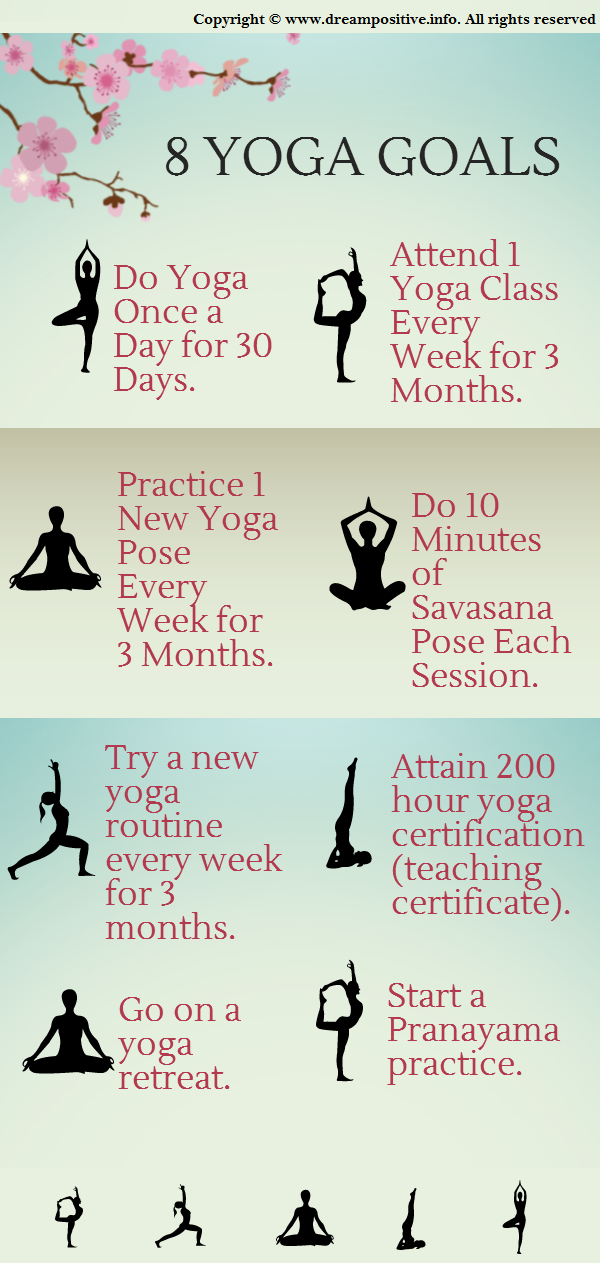
    If you’ve been dabbling with yoga, maybe it’s time to take it to the next level by setting some yoga goals, or even one yoga goal.

    The fact is that a progressive yoga practice practice requires setting simple and attainable yoga practice goals in a way that’s not future oriented.

    We do yoga practice to experience a benefit of some sort, so goal-setting is part of that process in order to reach and enjoy the benefit.

    This inspiring yoga infographic presents 8 great yoga practice goals any yogi can pursue to deepen their practice. The end result of the goals is to help yogis deepend their yoga practice and/or learn more.

    8 yoga practice goals

    Yoga goals are for every anyone looking to deepen their practice … from yoga teachers to the person doing yoga for the very first time. Read this informative infographic today and decide on one simple yoga goal that you can get started with immediately.